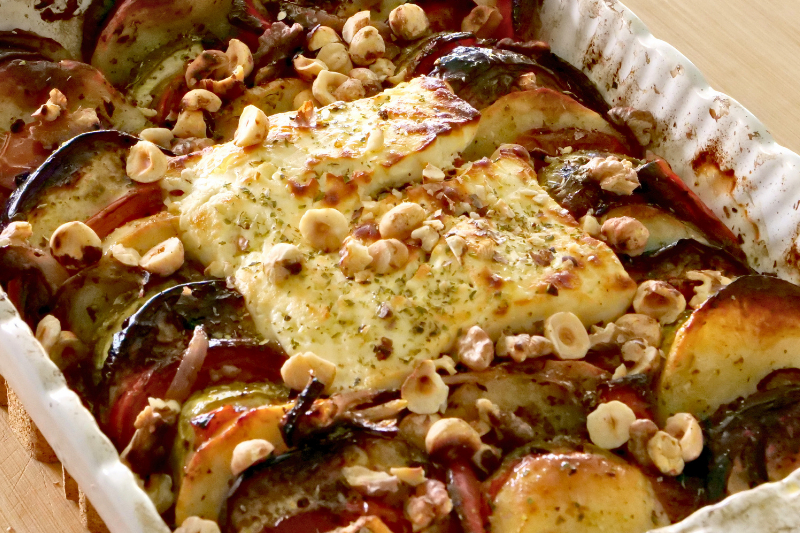
Ladolemono Briam with Melted Feta and Toasted Walnuts
Briam is the Greek roasted vegetable dish that predates ratatouille by centuries and outlasts every food trend — because it is not a trend. It is what Ikarians have eaten every summer for as long as anyone on the island can remember, and Ikaria is one of the world's five Blue Zones, the places where people routinely live past 100 in good health and sharp mind. This is the briam recipe I make on Ikaria, my family's home island, and it has one technique that most briam recipes — including the ones I've published before — leave out entirely.
That technique is the ladolemono marinade. Before any vegetable touches the pan, everything — the zucchini, eggplant, potato, pepper, tomato, and onion — gets tossed by hand in a vigorously whisked mixture of Greek extra virgin olive oil, fresh lemon juice and zest, grated garlic, and dried Greek oregano. The mixture is almost creamy when it comes together. The vegetables rest in it for at least 20 minutes, ideally an hour. In that time, the potato and eggplant absorb the olive oil and lemon into their flesh. The flavor goes inside the vegetable, not just on its surface. It is a small step that produces a completely different dish.
The briam then bakes long and slow — first covered, to steam and soften, then uncovered, to concentrate and char. The char is not optional. The edges of the vegetables need to darken, the pan juices need to reduce to a glossy, almost jammy pool, before the dish is done. Pull it early and you have a pleasant vegetable bake. Give it the time and the heat it needs and you have something you will make every week for the rest of summer.
It finishes with a thick slab of Greek feta laid directly on top of the hot vegetables for the final ten minutes of baking. The feta softens, goes golden at the edges, and releases its brine into the dish. Toasted walnuts go on last — because Ikarians have always finished their vegetable dishes this way, and because the research on walnuts in the context of a Mediterranean diet is, at this point, extraordinary.
This is longevity food. Not because someone decided to call it that, but because the people who have been eating it for generations keep living long enough to make it again. For more Ikarian longevity recipes, explore my Ikaria Diet Premium Recipe Club or join me on the island for my 2026 Blue Zone Cooking Retreats.
Ingredients
Vegetables
- 3 medium zucchini cut into ½-inch rounds
- 1 medium eggplant cut into ½-inch rounds
- 2 medium waxy potatoes peeled and sliced ¼-inch
- 1 red bell pepper seeded and cut into wide strips
- 3 large ripe tomatoes sliced ¼-inch
- 1 red onion sliced into thin rings
Ladolemono Marinade
- 100 ml extra virgin Greek olive oil
- 1 lemon juice and zest
- 4 garlic cloves grated
- 2 tsp dried Greek oregano
- 1 tsp sea salt
- ½ tsp black pepper
To Finish
- 150 g Greek feta in one thick slab
- 60 g walnuts hazelnuts, or a mix — lightly toasted and roughly crushed
- 15 g fresh flat-leaf parsley or fresh oregano
- 30 ml extra virgin Greek olive oil to finish
Instructions
-
Make the ladolemono: Whisk together olive oil, lemon juice and zest, grated garlic, oregano, salt, and pepper in a large bowl until almost creamy — about 30 seconds of vigorous whisking. Taste: it should be punchy, garlicky, and bright.
-
Massage and marinate: Add all vegetables to the bowl. Use your hands to toss and massage thoroughly, coating every surface. Rest in the marinade at least 20 minutes, turning once. An hour is better. The potato and eggplant especially need the time. This is the filming moment — show the bowl of vegetables sitting in the ladolemono before they go in the pan.
-
Layer and bake covered: Preheat oven to 180°C (350°F). Lightly oil a large baking dish. Arrange the marinated vegetables in overlapping rows, alternating varieties. Scrape every drop of ladolemono over the top. Cover tightly with parchment then foil. Bake 45 minutes.
-
Uncover and char: Remove foil and parchment. The vegetables should be soft and the juices bubbling. Return uncovered and roast until the edges are lightly charred and the pan juices have reduced to a concentrated, glossy pool. Finish under the broiler 3–4 minutes if needed. The char is not optional.
-
Toast the nuts: In a dry skillet over medium heat, toss nuts 3–4 minutes until fragrant and just coloured. Tip onto a board and roughly crush — uneven pieces, not dust.
-
Add feta and finish: Lay the feta slab directly on top of the hot vegetables. Return to oven 8–10 minutes until feta softens and the edges turn pale gold. Scatter toasted nuts over everything, tear herbs on top, drizzle generously with EVOO. Serve straight from the pan.
Notes
What is Briam — and Why is it Different from Ratatouille?
Briam is a Greek vegetable bake from the ladera family — the category of Greek dishes cooked generously in olive oil as the primary cooking medium, without dairy or meat. It is made with the summer vegetables that peak simultaneously in the Mediterranean garden: zucchini, eggplant, tomatoes, bell pepper, potato, and onion. It has been on Greek tables in this form for centuries. I have published several versions of briam over the years — from the classic casserole to a briam baked with eggs to a briam vegetable tart in puff pastry. This ladolemono version is the one I consider the most important, because the marinade technique changes the fundamental character of the dish.
Ratatouille is a Provençal French dish with a similar cast of vegetables. The comparison is inevitable and the Greek version is older. The critical difference — beyond geography and history — is olive oil: briam uses it in quantities that would alarm a French cook, and that generosity is nutritional strategy. Olive oil is the medium through which the fat-soluble antioxidants in the vegetables — lycopene from the tomatoes, beta-carotene from the peppers — become bioavailable to the body.
The Ladolemono Technique — Why This Briam is Different
Ladolemono is the foundational Greek sauce and marinade: olive oil and lemon, whisked together with garlic and oregano until they almost emulsify. You know it from Greek salad dressings and grilled fish. What most briam recipes skip is applying it as a marinade before the vegetables go in the oven — giving the potato and eggplant in particular time to absorb the flavors into their flesh rather than just their surface. Twenty minutes is the minimum. An hour is better. The difference in the finished dish is significant enough that I now consider this step non-negotiable.
The Char — Don't Pull it Early
Every baked vegetable dish has a moment when it looks done but isn't. The vegetables are soft, the juices are bubbling, everything smells correct. That is not the moment to pull the dish from the oven. The moment is ten minutes later, when the edges of the outer vegetables have darkened to a true char, when the pan juices have reduced from a pool to a glaze, when the tomatoes at the top have begun to collapse and concentrate. That is when briam is ready. Give it the heat. Trust the char.
Walnuts, Feta, and the Longevity Connection
The walnuts in this recipe are not a garnish. Walnuts are the most omega-3-rich nut in the Mediterranean pantry, and the PREDIMED trial — the landmark Mediterranean diet cardiovascular study — found that a daily 30g portion of mixed nuts including walnuts was associated with a 30% reduction in major cardiovascular events over five years. Ikarians have been finishing vegetable dishes with toasted walnuts not because they read the PREDIMED trial, but because their food culture arrived at the same place through generations of lived experience. For more on the Ikarian approach to food and longevity, explore my book The Ikaria Way or my online Flavors of Ikarian Longevity class.
The feta adds probiotic cultures — but only if it is real Greek PDO feta, made from sheep's milk with live cultures intact. Look for 'feta PDO' on the label. You can find authentically sourced Greek ingredients including PDO feta in my online Greek pantry shop.
Serving Briam — Main Course or Meze?
In Ikaria, briam is a main course. A generous pan of it, a thick wedge of feta alongside, good bread for the juices at the bottom of the pan, and perhaps a bowl of olives. That is a meal. In a larger spread it works as a side alongside grilled fish or baked salmon or biftekia — though in summer, on the island, it rarely needs the company. Briam is one of the few dishes that improves overnight. Make it the day before, reheat gently or serve at room temperature, and it will be better than it was the first time.
CHEF'S NOTES
The 20-minute marinade rest is the technique that defines this recipe. The potato and eggplant absorb the oil and lemon into their flesh — flavour is inside the vegetable, not just on the surface.
Char is non-negotiable. Pull it early and it is a steamed vegetable dish.
Feta as a slab, not crumbled — a slab holds its shape and gets the golden edge that makes the dish look finished.
Nut choice: walnuts for the strongest longevity story (ALA omega-3); hazelnuts for warmth and sweetness; both together for the PREDIMED combination.
This briam is better the next day. Make it ahead, cover, refrigerate, and reheat gently or serve at room temperature.
Q&A
What is briam in Greek cooking?
Briam is a traditional Greek roasted vegetable dish from the ladera family — dishes cooked generously in olive oil as the primary medium. It typically includes zucchini, eggplant, potato, tomato, bell pepper, and onion, slow-roasted in the oven with herbs and a generous pour of Greek extra virgin olive oil. It is one of the most important dishes of the Greek vegetarian table and the Mediterranean diet.
Is briam the same as ratatouille?
Briam and ratatouille share similar vegetables but are distinct dishes from different culinary traditions. Briam is Greek, uses olive oil as its primary cooking medium in larger quantities, and typically includes potatoes. Ratatouille is French and Provençal. Briam predates the modern popularization of ratatouille and has deep roots in Ikarian and Greek island cooking.
What is ladolemono and why is it used in this briam?
Ladolemono is the foundational Greek marinade and sauce: extra virgin olive oil and fresh lemon juice whisked together with garlic and dried oregano until almost emulsified. In this recipe it is used as a pre-roast marinade for all the vegetables, allowing the olive oil and lemon to penetrate the flesh of the potato and eggplant before baking. The result is vegetables that are flavored from the inside, not just on the surface.
Can briam be made ahead?
Yes — briam is one of the rare dishes that genuinely improves overnight. The vegetables continue to absorb the olive oil and pan juices as the dish cools. Make it the day before, store covered in the refrigerator, and reheat gently or serve at room temperature.
Is this briam recipe vegan?
The base briam recipe — all the vegetables and the ladolemono marinade — is completely vegan. The feta slab and toasted walnuts are finishing elements that can be omitted for a fully vegan dish. Without the feta, the recipe is plant-based and vegan.
What does briam taste like?
Briam tastes deeply savory, slightly sweet from the slow-roasted tomatoes and onions, and richly flavored with olive oil, lemon, and herbs throughout. The texture is soft and yielding with concentrated, jammy pan juices at the bottom. The char on the vegetable edges adds a smoky, caramelized note that distinguishes a properly cooked briam from a steamed vegetable dish.
Where can I learn more Ikarian longevity recipes?
Join Diane on Ikaria for her 2026 Blue Zone Cooking Retreats, take her online Flavors of Ikarian Longevity online class, or explore the full archive of Ikaria longevity recipes on this site. You can also subscribe to the newsletter for weekly Mediterranean diet recipes and Ikarian cooking inspiration.