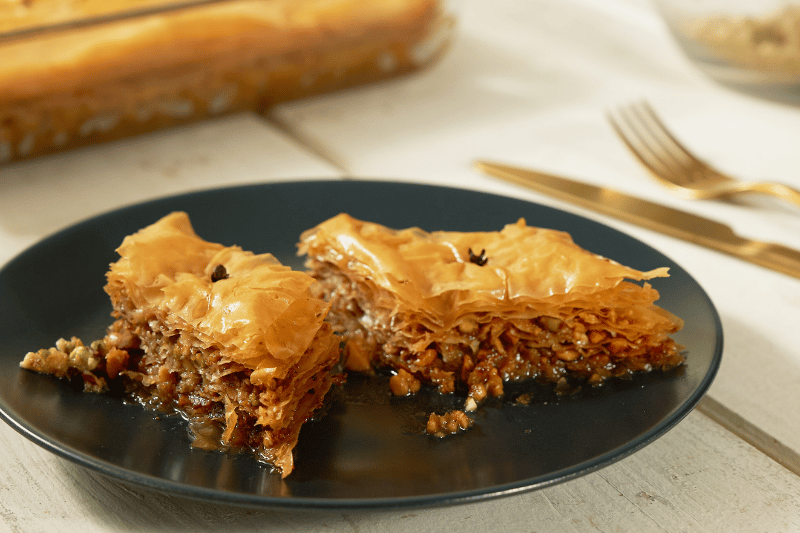
Classic Greek Baklava
Greek Baklava is one of the most iconic phyllo desserts in the Eastern Mediterranean—a celebration dessert that turns paper-thin pastry into something crisp, layered, and jewel-like. In the spirit of “Phyllo for Healthy Fun” (from My Greek Table Season 5: Flavors of Longevity), baklava is a reminder that a longevity lifestyle isn’t only about restraint—it’s also about pleasure, tradition, and sharing.
This is a dessert designed for hospitality: baked in a pan, cut into diamonds or squares, and offered generously. And while it’s an indulgence, it’s built from Mediterranean pantry ingredients—nuts, honey, citrus, and spice—enjoyed the way Greeks often enjoy sweets: in small portions, slowly, and together.
PREP TIME 45 minutes
COOK TIME 1 hour 45 minutes
TIME 2 hours 30 minutes
SERVES 12
Ingredients
For the Syrup
- 2 cups sugar
- 1/3 cup Greek pine honey
- 4 cups water
- 1 cinnamon stick
- 4 whole cloves
- 1 strip orange zest
- 1 strip lemon zest
- 2 Tbsp. strained fresh lemon juice
For the Baklava
- 1/2 pound/220g good quality unsalted butter preferably sheep’s-milk butter, more if needed
- 8 cups coarsely chopped walnuts blanched almonds or pistachios, or a mixture of any or all
- 1 cup finely ground rusks of choice or zwieback biscuits
- 1 teaspoon cinnamon powder
- 1/2 teaspoon ground cloves
- 1/2 teaspoon ground nutmeg
- 1/4 cup sugar
- Grated zest of 1 orange
- 1 pound commercial phyllo
- Whole cloves for the top of the baklava
Instructions
-
Make the syrup for the Baklava: Combine all the ingredients for the syrup in a medium saucepan and simmer for 10 to 12 minutes, until slightly thickened. Remove from heat and let the syrup cool to room temperature while the baklava bakes. You can push that along by placing it in the fridge for a bit, too.
-
Place butter in a small saucepan and heat slowly over low heat. Remove pan from heat and cool for 2 to 3 minutes. You can clarify it if you want (I usually don’t bother!) but it will make for a more crispy end result. To do that: With a spoon, skim the milky foam from the top of the butter (you can stir it into the nut mixture so as not to waste anything). Set aside until ready to use.
-
Preheat oven to 400˚F/200˚C. Lightly butter a 9 X 12 X 2-inch deep baking pan.
-
In a large bowl, combine nuts, ground zwiebeck or rusks, sugar, cinnamon powder, ground cloves and nutmeg and orange zest. Add the butter foam if you’ve clarified it, or just a couple (2) of tablespoons of melted butter and mix to combine everything.
-
Cut the phyllo in half so that the sheets are about the same size as the baking dish. Butter the baking dish. Layer 4 - 6 phyllo sheets on bottom of prepared baking pan, one at a time, brushing each one generously with butter. Sprinkle a few tablespoons of the nut mixture over the surface. Place two more phyllo sheets on top, buttering each and sprinkling the top layer with a few more tablespoons of the nut mixture. Layer two more sheets, buttering each and sprinkling another few tablespoons of nuts on top. Continue for a few more layers of phyllo, two sheets at a time as before, buttering each and topping with nuts, until the nuts are used up. Top the baklava with 4 to 5 more phyllo sheets, brushing each with butter.
-
Score the Greek baklava into diamonds or squares and pierce each piece with a clove, which adds flavor and helps keep the phyllo sheets in place. Sprinkle the top with a few drops of water and bake for 10 minutes.
-
Reduce heat to 325˚F/165˚C and bake for about 1 ½ hours, or until baklava is golden brown and the interior layers thoroughly baked. If desired, five minutes before removing baking pan from oven, brush baklava with any remaining butter -- this makes it even crispier and adds great flavor.
-
Remove baking pan from oven and pour the cooled syrup over the hot baklava. If you have any melted butter left, drizzle it over the top. Place the baklava back in the oven – which has been turned off but is still hot – and let stand until all the syrup is absorbed, about 20 minutes. Serve baklava warm or at room temperature and store at room temperature, sealed in a tin.
Notes
Nutrition & Tips
Crispness rule: Cool syrup over hot baklava is the key to crisp layers.
Portion tradition: In the Mediterranean, sweets are often enjoyed in smaller pieces, slowly, with coffee and company—part of the “healthy fun” lifestyle.
Nut flexibility: Walnuts are classic, but pistachios and almonds work beautifully.
Storage: Keeps well at room temperature, tightly covered.
If you like this recipe, you will love these three dishes, too:
• Easy Baklava Crinkle Pie
• Ioannina-Style Baklava
• Baklava Butter Board